
Filmmaker Spotlight
Xinran Gu
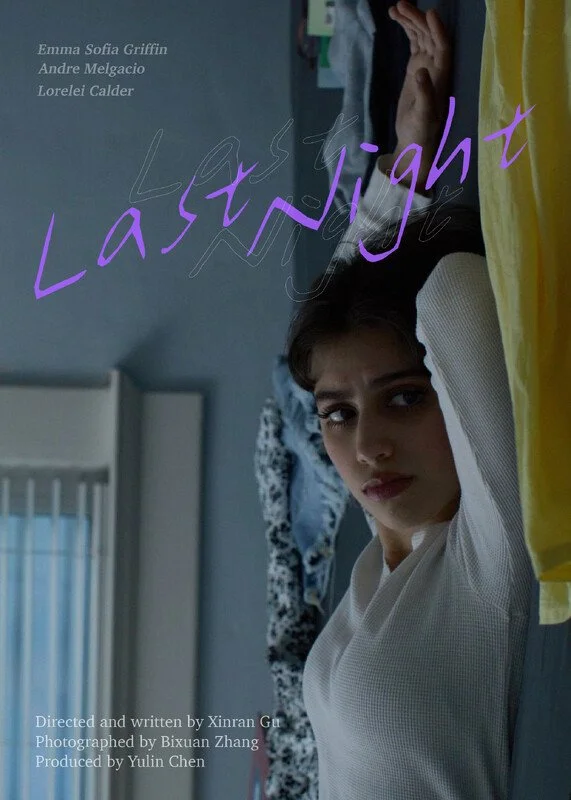
Last Night
Director: Xinran Gu
Country : USA
Runtime: 7:01
Genre: Narrative
Language: English
Completion Year: 2024
Links: Instagram
Synopsis
On a vacation, sensitive and vulnerable Becky tries to gain self-esteem by sudcing a man who is pursuing her sister.

About the Director
Xinran Gu is a Chinese filmmaker and motion designer currently pursuing an MFA in Film at the Savannah College of Art and Design (SCAD). With a background in Digital Media Art, Xinran brings a unique blend of visual storytelling and motion design to her filmmaking, crafting narratives that are both emotionally resonant and visually striking.
As a director, Xinran gravitates towards stories that explore the fragility of human emotions, the nuances of female perspectives, and the unsettling complexities of relationships. Her work often delves into themes of identity, longing, and the psychological tension between appearance and reality, using carefully composed cinematography and atmospheric lighting to heighten emotional depth.
Xinran’s work reflects her belief that the most profound emotions often exist in silence, and her films strive to capture these delicate, often unspoken moments with authenticity and depth. She continues to develop projects that explore the complexity of female experiences, using her distinct cinematic voice to shed light on perspectives that are often overlooked or understated.
Director Statement
I have always been drawn to stories that unfold in the space between what’s felt and what’s said—between expectation and reality, between fleeting hope and quiet disillusionment. As an Asian female director, I am particularly committed to exploring the emotional interiority of women—their moments of self-doubt, desire, and unspoken longing. Last Night is a film rooted in those silent emotional spaces, told with restraint, precision, and visual sensitivity.
At its core, Last Night is about perception—how we construct meaning through another person’s gaze, and how easily that meaning can collapse. Becky, our protagonist, mistakes attention for affection, placing too much weight on a moment that was never mutual. The film opens in soft, warm light, mirroring Becky’s tentative hope that something real is unfolding. But as the night deepens, the visual tone shifts—colder, distant, stripped of warmth—revealing the quiet unraveling of an illusion she held alone.
By morning, Becky is frozen in the aftermath of something no one else remembers. The world moves on; her heartbreak goes unseen. In that final image—Becky standing still while everyone else continues—we see the ache of emotional invisibility, a feeling many women know but rarely see represented.
This project was driven by a core team of Asian female creators. I served as the writer, director, editor, working closely with a fellow Asian female DP. Together, we built a visual language that allowed softness and sorrow to coexist—where beauty carries tension, and silence holds truth. We aimed not to explain emotions, but to let them linger.
Last Night is not about romantic heartbreak in the traditional sense. It’s about the ache of being the only one who felt something real—and the quiet cruelty of a world that never pauses to notice. As a filmmaker, I gravitate toward narratives that don’t resolve easily but ask the viewer to sit in what’s left behind.